
Take Your Practice to Higher Ground
24 August 2026 · By PIERRE
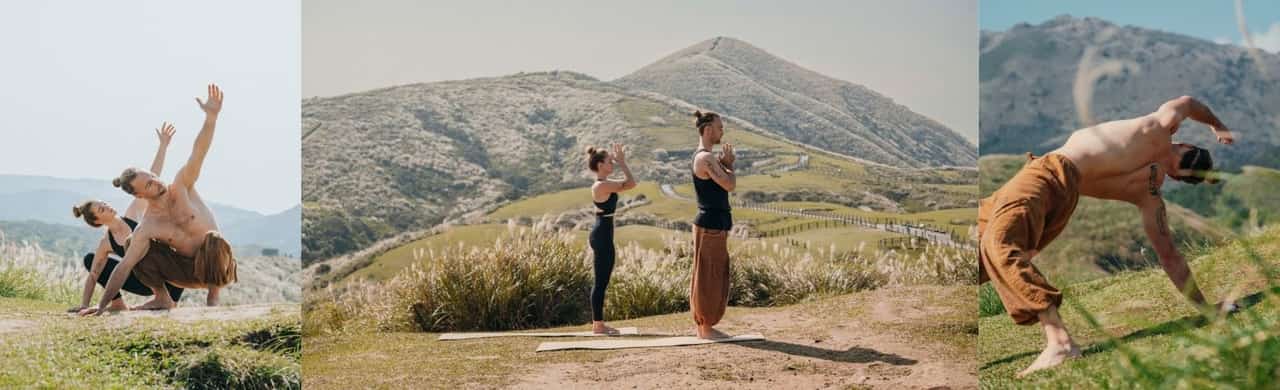
There is a moment, early in a mountain morning, when the air is still cool and the light is low and everything feels slightly more awake than usual.
Your hands press into the earth. Your breath moves differently up here. The body settles in a way it does not always manage indoors.
Outdoor yoga practice asks something different of the practitioner. And in return, it gives something back that four walls rarely can.
Why Outdoor Yoga Practice Changes What the Body Does
The relationship between nature and the nervous system is well documented. Time spent in natural environments measurably reduces cortisol levels, lowers heart rate, and shifts the body into a parasympathetic state — the same state that yoga actively cultivates. In practice, combining the two is not simply additive. The effects compound.
There is also something more immediate at work. On an outdoor yoga mat, the ground beneath you is real. Uneven, textured, alive in small ways. The body responds to that variation differently than it does to a flat studio floor. Proprioception, the body's sense of its own position in space, sharpens when the surface is less predictable. Balance postures require more. And as a result, they give more.
Furthermore, the breath outdoors carries more than oxygen. Open air, particularly at altitude, changes the quality of the inhale. Practitioners often report that pranayama feels more instinctive and less effortful outside. The landscape does some of the work.
The Outdoor Yoga Mat That Earns Its Place Outside
Not every mat belongs outdoors. Studio mats often rely on flat, clean surfaces for grip. Many synthetic materials degrade in UV light or become slippery in humidity. And most mats are not built to carry.
The Locust Mat is different. Made in Alicante, Spain, from natural rubber, it is built for the kind of practice that moves between settings. The warm brown tones and natural texture read as belonging outdoors in a way that a bright synthetic mat simply does not. Place it on rock, on grass, on a sun-warmed wooden deck — it holds.
Alicante brings a particular quality to natural rubber production. The climate, the manufacturing tradition, and the proximity to raw materials all matter. The result is a mat with real grip, real texture, and a surface that improves with use rather than degrading.
Natural rubber, moreover, does not off-gas the way PVC and TPE materials do. Outdoors, that distinction becomes irrelevant — the air carries it away regardless. But it says something about the material itself: honest construction, built to last, nothing hidden.
Where Outdoor Yoga Practice Belongs
The obvious answer is mountains. And mountains are right — there is something about altitude that strips the practice down to what it actually is. No distractions, no mirrors, no ambient sound beyond wind and breath.
But outdoor yoga does not require altitude to change. A garden in the early morning works. A hillside at dusk. A park before the day fills up. The principle is the same wherever you go: step outside the familiar setting, and the practice steps outside itself too.
Some practitioners find that the structure of indoor practice — the set sequence, the familiar cues, the predictable room — becomes a kind of comfort that gradually narrows the experience. Taking the mat outside disrupts that pattern gently. The body has to pay attention again.
How to Prepare for an Outdoor Practice
Outdoor yoga is not the same as studio yoga moved outdoors. A few adjustments make the difference between a session that feels awkward and one that feels entirely natural.
- Choose a surface that is as level as you can find, but do not wait for perfection. Slight inclines and variations in texture are part of what makes outdoor practice valuable.
- Practise early or late in the day when light is softer, heat is lower, and the site is quieter. The quality of the session tends to reflect the quality of the light.
- Anchor your sequence around the breath rather than the shape. Outdoors, the shapes matter less. The breath matters more.
- Bring a mat that is built for the conditions. The Locust Mat's natural rubber base holds grip on uneven ground and does not slide on grass or stone the way studio mats often do.
- Give yourself time to arrive. Five minutes seated, hands on the earth, before any movement begins. Let the nervous system register where it is.
The Locust Mat in Practice
The Locust Mat comes from Alicante in Spain, a city whose relationship with craft and natural materials runs deep. It is made from natural rubber, built for both indoor and outdoor practice, and finished in warm earth tones that feel considered rather than branded.
It is not a mat that announces itself. It is a mat that disappears beneath the practice and lets the practice be the thing.
That quality matters particularly outdoors, where the environment is already doing considerable work. A mat that competes with its surroundings breaks the spell. The Locust holds the ground and gets out of the way.
For practitioners who already own a cork mat for studio use, the Locust makes a natural companion for outdoor sessions. The two materials, cork and natural rubber, behave differently in different conditions. Cork performs best in warm, dry indoor environments. Rubber holds in varied outdoor conditions, wet or dry.
Why Where You Practise Matters
Yoga philosophy has always held that the environment of the practice shapes the quality of the practice. In Patanjali's Yoga Sutras, the concept of saucha — purity and cleanliness — extends to the space around the practitioner as much as to the body itself. A clean, honest environment supports a clean, honest practice.
Nature is not always tidy. But it is honest. And that honesty, felt underfoot through a mat that is itself made honestly, creates a particular quality of attention.
That is what higher ground offers. Not elevation for its own sake. But a different quality of presence.
Frequently Asked Questions
Is the Locust Mat suitable for outdoor use?
Yes. The Locust Mat is made from natural rubber and built for both indoor and outdoor practice. Its texture and grip perform well on varied surfaces including grass, stone, and wooden decking. The warm brown tones and natural finish are also well suited to outdoor settings.
What makes a yoga mat suitable for outdoor practice?
An outdoor yoga mat needs grip that works on uneven and potentially damp surfaces, durability in varying light and temperature conditions, and materials that do not degrade quickly under UV exposure. Natural rubber performs well across all three. The Locust Mat is made from natural rubber in Alicante, Spain, and is built for practice that moves between settings.
Does practising yoga outdoors have proven benefits?
Yes. Research consistently shows that time in natural environments reduces cortisol, lowers heart rate, and activates the parasympathetic nervous system — the same state that yoga practice cultivates. Combining the two tends to compound those effects rather than simply add them together.
Where is the Locust Mat made?
The Locust Mat is made in Alicante, Spain. PIERRE makes all its products in Europe — in Portugal, Spain, Germany, Bulgaria, and Italy. Every product has a country, a maker, and a reason for being what it is.
Can I use the Locust Mat in a studio as well as outdoors?
Yes. The Locust Mat works equally well in studio settings. Natural rubber provides reliable grip on smooth studio floors and on outdoor surfaces. For practitioners who move between indoor and outdoor practice, it serves as a single mat for both.
A Thought
The practice does not need four walls. It just needs you, a surface worth standing on, and enough space to breathe.
Take It Outside
Explore the Locust Mat in the PIERRE shop, alongside the full range of European-made yoga equipment. Find out more about how every product is made on the Our Story page.
Continue Reading

10 July 2026
Yoga & Trail in the Austrian Alps
Five days to move, slow down and come back to yourself — hosted at Der Baum, surrounded by forest and silence in the Austrian Alps.
29 May 2026
How to Set Up a Corporate Wellness Yoga Programme
The Workplace Is Ready for This Something is shifting in how forward-thinking companies think about their people. Not just productivity. Not just performance metrics. But the quieter, more human quest…
15 May 2026
How to Build a Sustainable Yoga Studio: Equipment Guide
Every yoga studio starts with a vision. A space where practitioners arrive carrying the weight of their week and leave feeling lighter. A room that holds the practice without interrupting it. A place …